Automatic Polymer Preparation Unit

Automatic Polymer Preparation Unit

Solids Handling, Screening & Sludge Treatment Equipment
Automatic Polymer Preparation Unit

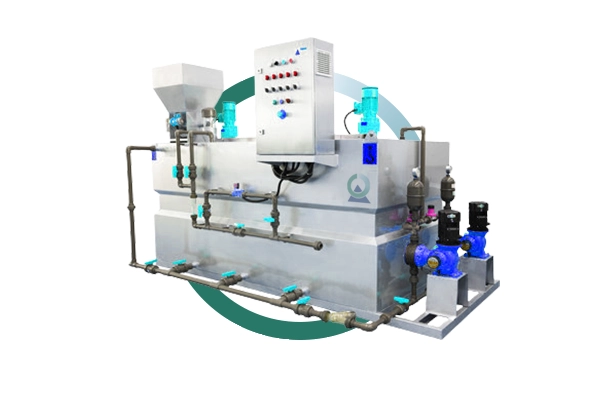
The Automatic Polymer Preparation Unit is a system that prepares and doses polymer accurately for wastewater treatment. It automatically adjusts the dosing using smart controls and monitoring, and reduces the chemical waste. The process has three stages: wetting, dissolving, and aging. Its fully automated design means less manual work and lower operating costs. Built from durable stainless steel with a compact, skid-mounted design, it’s easy to install, maintain, and expand (if needed). Overall, it’s a reliable and cost-effective product for modern water and wastewater treatment.

FA 01

1. What is an automatic polymer preparation unit?

It is a system that mixes and prepares polymer solutions automatically for use in wastewater treatment processes.

2. Why is polymer preparation important?

Proper preparation helps improve sludge treatment, making it easier to separate solids from water and improving overall efficiency.

3. Which sectors can use the automatic polymer preparation unit?

It is popular among the papermaking industry, industrial wastewater treatment, municipal wastewater treatment plants, and other industries that use flocculant solutions.

4. Can it handle different types of polymers?

Yes, it can work with both dry and liquid polymers and can be adjusted for different needs.

Specification and Parameters 01
Model Capacity (L/h) Powder hopper capacity (L) Material Power (kW) L (mm) W (mm) H (mm) Weight (kg)
AQT-500L 500 65 SUS304 0.99 1400 1520 1870 280
AQT-1000L 1000 65 SUS304 0.99 2000 1300 1660 410
AQT-2000L 2000 65 SUS304 1.36 2440 1520 1965 550
AQT-4000L 4000 65 SUS304 1.36 3000 1800 2115 680
AQT-5000L 5000 65 SUS304 3.55 4000 1550 1830 960
AQT-6000L 6000 65 SUS304 3.55 4000 1800 2080 1050
AQT-8000L 8000 65 SUS304 4.65 4500 1800 2100 1280
AQT-10000L 10000 100 × 2 SUS304 4.90 5000 1800 2100 1560
Feature 01

Features

Standard Features

  • Durable SS304 stainless steel construction (SS316 available) for corrosion resistance
  • Three-stage preparation system: Integrated tanks provide continuous wetting, dissolving, and aging for a stable, consistent polymer solution with minimal labour.
  • Integrated IoT monitoring and smart sensors for continuous measurement of chemical levels, flow rates and overall system performance
  • Level sensors and interlocks for safe, reliable performance
  • Compact skid-mounted frame for quick installation
  • Easy maintenance with service-friendly layout


Options & Accessories

  • Alternative polymer feeding systems: screw feeder, vacuum conveyor, bag-break station
  • Customised solution thanks to meet specific capacities
  • Additional agitation or recirculation pumps for challenging polymers
  • Remote monitoring and data logging
  • Low-level alarms and auto-stop protection
  • Integrated dosing pumps and pipelines for turnkey installations
Working principl 01

Working Principle

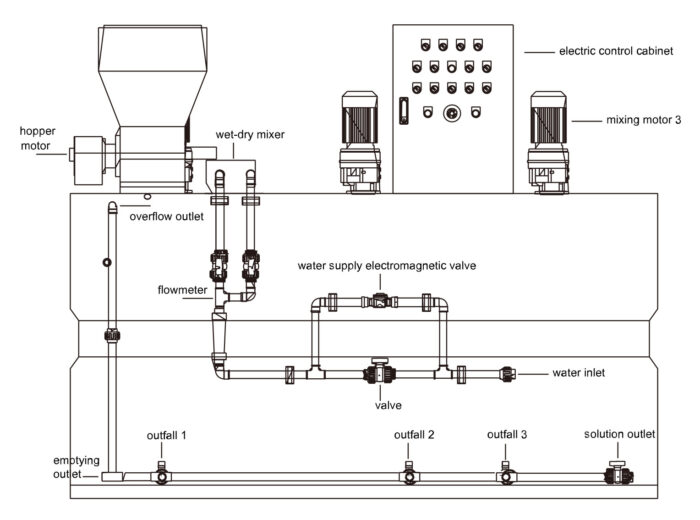
Dry or liquid polymer is conveyed to the wetting chamber, where it is rapidly and uniformly mixed with water to avoid clumping. The wet polymer is then introduced into the dissolving chamber for complete hydration. It then enters the aging/maturation chamber to reach the required concentration. Automated sensors, valves, and PLC controls maintain optimal preparation conditions. The ready solution is transferred on demand to dosing points.

Automatic Polymer Preparation Unit working principles

Key Benefits 01

Key Benefits

  • Precision Dosing: Advanced algorithms (AI-Optimised ) automatically fine-tune polymer dosing in real time, eliminating operator error, ensuring optimal treatment performance, and preventing chemical overuse.
  • Labour Savings: Fully automated preparation and dosing minimise hands-on work, lowering operational costs and allowing staff to concentrate on higher-value activities.
  • Enhanced Efficiency: Reliable polymer delivery maintains stable process conditions, boosting solids removal efficiency and compliance with stringent environmental regulations.
  • Smart Monitoring: Integrated IoT sensors continuously track polymer concentration, flow rates and system status, enabling proactive adjustments and rapid troubleshooting.
  • Environmental Sustainability: Smart optimisation reduces polymer wastage and energy demand, supporting corporate sustainability goals and global environmental initiatives.
  • Cost-Effective: Lower polymer consumption, reduced maintenance needs and extended equipment life deliver measurable OPEX savings over time.
  • Flexible & Scalable: Configurable to handle diverse wastewater characteristics and plant capacities, from small municipal systems to large industrial installations.


Key-mobile

Key Benefits

  • Precision Dosing: Advanced algorithms (AI-Optimised ) automatically fine-tune polymer dosing in real time, eliminating operator error, ensuring optimal treatment performance, and preventing chemical overuse.
  • Labour Savings: Fully automated preparation and dosing minimise hands-on work, lowering operational costs and allowing staff to concentrate on higher-value activities.
  • Enhanced Efficiency: Reliable polymer delivery maintains stable process conditions, boosting solids removal efficiency and compliance with stringent environmental regulations.
  • Smart Monitoring: Integrated IoT sensors continuously track polymer concentration, flow rates and system status, enabling proactive adjustments and rapid troubleshooting.
  • Environmental Sustainability: Smart optimisation reduces polymer wastage and energy demand, supporting corporate sustainability goals and global environmental initiatives.
  • Cost-Effective: Lower polymer consumption, reduced maintenance needs and extended equipment life deliver measurable OPEX savings over time.
  • Flexible & Scalable: Configurable to handle diverse wastewater characteristics and plant capacities, from small municipal systems to large industrial installations.


working-mobile

Working Principle

Dry or liquid polymer is conveyed to the wetting chamber, where it is rapidly and uniformly mixed with water to avoid clumping. The wet polymer is then introduced into the dissolving chamber for complete hydration. It then enters the aging/maturation chamber to reach the required concentration. Automated sensors, valves, and PLC controls maintain optimal preparation conditions. The ready solution is transferred on demand to dosing points.

Automatic Polymer Preparation Unit working principles

Features-mobile

Features

Standard Features

  • Durable SS304 stainless steel construction (SS316 available) for corrosion resistance
  • Three-stage preparation system: Integrated tanks provide continuous wetting, dissolving, and aging for a stable, consistent polymer solution with minimal labour.
  • Integrated IoT monitoring and smart sensors for continuous measurement of chemical levels, flow rates and overall system performance
  • Level sensors and interlocks for safe, reliable performance
  • Compact skid-mounted frame for quick installation
  • Easy maintenance with service-friendly layout


Options & Accessories

  • Alternative polymer feeding systems: screw feeder, vacuum conveyor, bag-break station
  • Customised solution thanks to meet specific capacities
  • Additional agitation or recirculation pumps for challenging polymers
  • Remote monitoring and data logging
  • Low-level alarms and auto-stop protection
  • Integrated dosing pumps and pipelines for turnkey installations
SaP
Model Capacity (L/h) Powder hopper capacity (L) Material Power (kW) L (mm) W (mm) H (mm) Weight (kg)
AQT-500L 500 65 SUS304 0.99 1400 1520 1870 280
AQT-1000L 1000 65 SUS304 0.99 2000 1300 1660 410
AQT-2000L 2000 65 SUS304 1.36 2440 1520 1965 550
AQT-4000L 4000 65 SUS304 1.36 3000 1800 2115 680
AQT-5000L 5000 65 SUS304 3.55 4000 1550 1830 960
AQT-6000L 6000 65 SUS304 3.55 4000 1800 2080 1050
AQT-8000L 8000 65 SUS304 4.65 4500 1800 2100 1280
AQT-10000L 10000 100 × 2 SUS304 4.90 5000 1800 2100 1560
FAQ

1. What is an automatic polymer preparation unit?

It is a system that mixes and prepares polymer solutions automatically for use in wastewater treatment processes.

2. Why is polymer preparation important?

Proper preparation helps improve sludge treatment, making it easier to separate solids from water and improving overall efficiency.

3. Which sectors can use the automatic polymer preparation unit?

It is popular among the papermaking industry, industrial wastewater treatment, municipal wastewater treatment plants, and other industries that use flocculant solutions.

4. Can it handle different types of polymers?

Yes, it can work with both dry and liquid polymers and can be adjusted for different needs.