
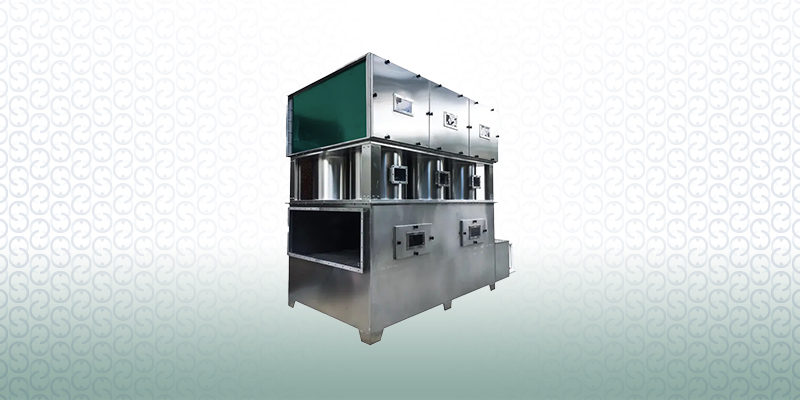

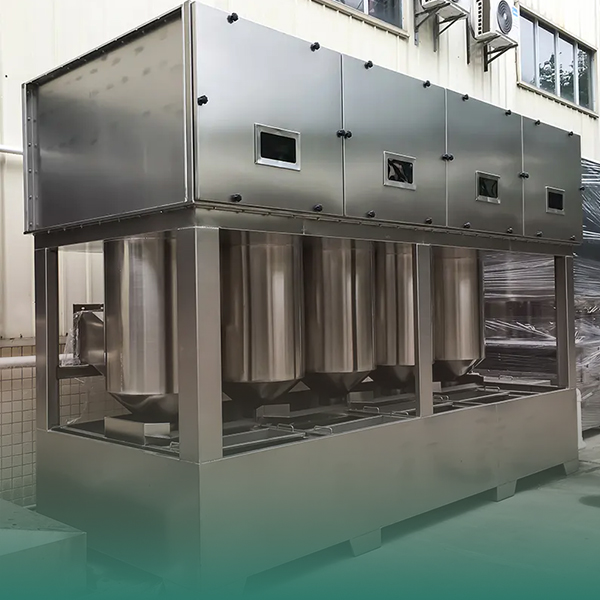

Hybrid cyclone

How It Works

The hybrid cyclone tower integrates five mechanisms — inertia, centrifugation, collision, emulsification and absorption — enabling complete treatment within one device.

1) Cyclonic Entrainment

Dust- or pollutant-laden exhaust gas enters the base of the tower tangentially under negative pressure from the induced draft fan. The gas passes through a cyclone generator with guide vanes, accelerating airflow to approximately 15–25 m/s and creating a strong swirling flow field that initiates centrifugal separation.

2) Gas–Liquid Emulsification

A recirculation pump delivers scrubbing liquid (water, alkaline solution or oxidising solution depending on duty) to spiral nozzles at the tower top. Counter-current spraying combined with high-speed swirl atomises droplets into micron-scale particles, forming an intensive gas–liquid emulsification zone.

  • Particles are driven to the tower wall by centrifugal force, where they collide with the liquid film and are washed downward.
  • Gaseous pollutants such as HCl, NH₃ and VOCs dissolve, neutralise or oxidise within the emulsification zone.

3) Centrifugal Separation

The emulsified flow enters a converging–diverging centrifugal cylinder. As the flow radius decreases, centrifugal force increases, throwing droplets and captured dust to the walls and directing them to the sump. Cleaned gas converges toward the centre and moves upward.

4) Packing Polishing & Demisting

The rising gas passes through one or more layers of structured packing (such as Pall rings or hollow balls) and secondary spray zones to remove residual contaminants. A mesh or plate demister at the top removes entrained droplets, ensuring compliant discharge.
The liquid circuit operates in a closed loop, with sediment periodically removed via sludge or scraping systems.

HYBRID CYCLONE SPRAY TOWERS

Applications

Spray painting

Automotive Spray Painting

Industrial Ventilation

Pharmaceutical Processing Vents

Exhaust

Metallurgical Exhaust Treatment

Waste gas

Waste Gas Pre-Treatment

Exhaust

Metal Grinding Exhaust

Odour control

Wastewater Odour Control

Gas Cleaning

Alkaline Gas Control

Boilers furnaces

Boiler & Kiln Exhaust

Core System Components

Aquiptec designs hybrid cyclone spray towers as fully integrated emission control systems tailored to duty, chemistry and airflow.

Cyclone Generator & Swirl Section

  • Tangential inlet and guide vane design
  • High-speed centrifugal pre-separation
  • Detachable and serviceable swirl modules
  • Materials including FRP, SUS304 or SUS316L

This stage reduces downstream fouling and enhances treatment stability.

Spray Absorption System

  • Counter-current spray with spiral large-diameter nozzles
  • Internal filtration and anti-clogging design
  • Recirculation pumps and liquid distribution
  • Configured for water, alkaline or oxidising solutions.

Centrifugal Separation Zone

  • Converging–diverging geometry
  • Enhanced droplet and particulate removal
  • Reduced load on packing and demister sections

This improves operational reliability and minimises clogging.

Packing & Polishing Section

  • Pall rings, hollow balls or structured packing
  • Secondary spray zones
  • Fine removal of residual contaminants

Supports high-efficiency gas purification and deep treatment.

Demisting & Dehydration

  • Wire mesh or corrugated plate demisters
  • High droplet capture efficiency
  • Clean, dry gas discharge

Ensures regulatory compliance and downstream protection.

Key Benefits

New improvement

Combined Particle & Gas Treatment

Removes dust, mist and soluble gaseous pollutants within a single integrated wet scrubbing system.

New artboard

Compact Integrated Design

Cyclone separation, spray absorption and demisting are combined in one tower, reducing footprint compared with conventional spray

High performance

High Efficiency & Process Stability

High-speed rotational airflow enhances gas–liquid contact and improves purification performance.

Control system

Reduced Clogging & Fouling Risk

Centrifugal pre-separation lowers particulate loading on packing and internal components.

Energy Efficient

Energy Efficient Operation

Variable frequency control & optimised pressure drop reduce fan energy usage & operating cost.

Robust Low Maintenance Design

Low Maintenance Requirements

No moving internal parts and simplified design minimise servicing needs and lifecycle cost.

By Product Management

Wide Application Flexibility

Handles sticky dust, oily mist, VOCs, acid gases and fluctuating industrial exhaust conditions.

Corrosion Resistant Design

Durable & Corrosion-Resistant Construction

Available in FRP, SUS304 or SUS316L materials to suit aggressive and high-temperature environments.

Why Choose AquipTec

Aquiptec delivers engineered hybrid cyclone spray tower solutions that strengthen emissions control and environmental compliance:

  • Duty-specific engineering based on pollutant type, temperature and loading
  • Corrosion-resistant and high-performance material selection
  • Integration with chemical dosing and monitoring systems
  • End-to-end delivery from design and installation through commissioning and support
  • Optimised lifecycle cost and operational reliability

This solution is engineered and delivered exclusively by Aquiptec.

Frequently Asked Questions (FAQ)

What makes hybrid cyclone towers different from conventional spray towers?

They combine centrifugal separation and spray absorption, improving efficiency and reducing clogging and maintenance.

Yes. The cyclone stage removes heavy or viscous particles before they reach packing, reducing fouling risk.

Water, alkaline, acidic or oxidising solutions depending on the target pollutants.

Yes. With appropriate oxidants or chemical dosing, it can remove NH₃, H₂S and other odour compounds.

Yes. Each tower is designed according to site airflow, pollutant profile and regulatory requirements.