



How It Works
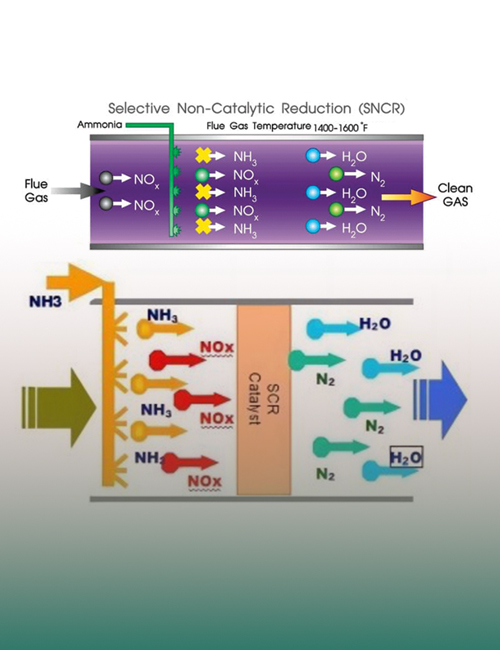
Gas denitration removes nitrogen oxides (NO and NO₂, collectively NOx) from flue or exhaust gas streams by promoting chemical reactions that convert NOx into harmless nitrogen (N₂) and water (H₂O).
1-Flue Gas Entry
NOx-containing exhaust gas from boilers, furnaces, kilns or process heaters enters the denitration system.
2-Reductant Introduction
A reducing agent, typically ammonia or urea solution, is injected into the gas stream.
3-Chemical Conversion
Under controlled temperature conditions, NOx reacts with the reductant:
- In Selective Catalytic Reduction (SCR), the reaction occurs over a catalyst.
- In Selective Non-Catalytic Reduction (SNCR), the reducing agent reacts directly without a catalyst.
The products of these reactions are nitrogen (N₂), water (H₂O), and, when urea is used, small amounts of carbon dioxide (CO₂).
4-Treated Gas Discharge
The treated gas, with significantly reduced NOx, is discharged to the atmosphere in compliance with licence conditions.
Applications

Cement

Boilers and Furnaces

Waste‑to‑energy

Power generation

Core System Components
AquipTec’s gas denitration systems are configured using purpose-designed components, optimised for each technology type:
SCR System Components
SCR utilises a catalyst to accelerate the reaction between NOx and a reductant (typically ammonia or urea), converting NOx into nitrogen and water. Integrated SCR system components include:
- Reductant Storage & Handling: Safe storage and dosing of ammonia or urea.
- Injection Grid & Mixing Zone: Precision injection ensures uniform reductant distribution.
- Catalyst Reactor Module: Packed catalyst beds where the NOx reduction reaction occurs.
- Temperature Control & Monitoring: Maintains optimal reaction conditions for maximum NOx removal.
- Instrumentation & Control: Real-time monitoring of NOx, temperature and reductant flow to support stable performance.
SNCR System Components
SNCR systems inject ammonia or urea directly into the flue gas stream without a catalyst, where the reductant reacts with NOx at 850–1100°C to form nitrogen and water. Integrated SCR system components include:
- Reagent Storage & Dosing: Ammonia or urea delivered to the flue gas at controlled rates.
- Injection Lances: Strategic placement ensures reaction occurs in the correct temperature window.
- Temperature & Reaction Control: Systems to monitor and maintain injection conditions for effective NOx conversion.
- Control & Safety Systems: Ensures safe reductant use and minimises ammonia slip.
Key Benefits

Effective NOx Reduction
SCR is efficient in NOx removal, and SNCR offers cost-effective control for moderate loads.

Accurate Reductant Control
Optimised ammonia/urea dosing maintains NOx conversion with minimal ammonia slip

Flexible Technology Selection
SCR or SNCR chosen to suit fuel type, temperature profile and required removal level.

Retrofit & New Build Compatibility
Gas denitration can be adapted to existing combustion sources and new facilities.

Lower Operating Costs
Efficient reductant use and advanced controls lower ongoing operating expenses.

Real-Time Monitoring
Continuous emissions monitoring and automation support consistent compliance.

Enhanced Plant Performance
Reduced NOx can improve downstream equipment life and reduce corrosion risk.

Australian Standards Alignment
Systems engineered to meet Australian industrial NOx limits.
Why Choose AquipTec
AquipTec delivers independent, engineered gas denitration solutions aligned with Australian combustion sources and regulatory expectations.
- Technology-neutral design approach
- End-to-end delivery from concept to commissioning
- Local engineering and ongoing support
- Solutions optimised for temperature, NOx levels and operating cost
Gas Denitration solution is engineered and delivered exclusively by Aquiptec.
Frequently Asked Questions (FAQ)
What are NOx emissions and why control them?
NOx refers to nitrogen oxides produced during combustion. They contribute to smog, acid rain and regulatory non-compliance.
How does SCR compare with SNCR?
SCR typically achieves higher NOx removal efficiencies and operates at lower temperatures; SNCR is simpler and has lower capital cost but moderately lower removal.
Is ammonia safe to use in denitration systems?
Ammonia (or urea converted to ammonia) is common in NOx control but must be handled with safety systems in place to minimise slip and ensure compliance.
Can denitration systems be retrofitted to existing plants?
Yes. Both SCR and SNCR solutions can be engineered as retrofit installations, with system design adapted to the existing flue gas path, available space, and operational constraints to ensure compliance without major process disruption.