Have any questions? call us

Belt Filter Press Dewatering

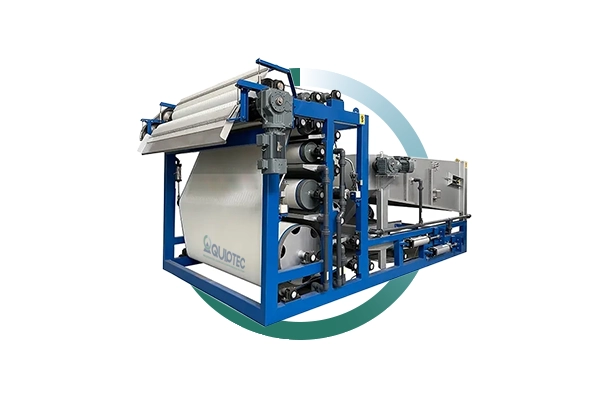




| Model | AQT-500 | AQT-1000A | AQT-1500A | AQT-1500B | AQT-2000A | AQT-2000B | AQT-2500A | AQT-2500B | AQT-3000 |
| Output Moisture Content (%) | 70–80 | ||||||||
| Polymer Dosing Rate (%) | 1.8–2.4 | ||||||||
| Dried Sludge Capacity (kg/h) | 100–120 | 200–203 | 300–360 | 400–460 | 470–550 | 600–700 | |||
| Belt Speed (m/min) | 1.57–5.51 | 1.04–4.5 | |||||||
| Main Motor Power (kW) | 0.75 | 1.1 | 1.5 | ||||||
| Mixing Motor Power (kW) | 0.25 | 0.25 | 0.37 | 0.55 | |||||
| Effective Belt Width (mm) | 500 | 1000 | 1500 | 1500 | 2000 | 2000 | 2500 | 2500 | 3000 |
| Water Consumption (m³/h) | 6.2 | 11.2 | 16 | 17.6 | 20.8 | 22.4 | 24.1 | 25.2 | 28.8 |

Features
Standard Features
- Stainless steel construction (SS304/SS316) for corrosion resistance and long service life
- Dual permeable filter belts for continuous solid-liquid separation
- Multi-stage dewatering zones (gravity, wedge, and pressure zones) for optimised performance
- Pneumatic belt tensioning and tracking system for stable operation
- High-quality filter belts with extended service life
- Roller system designed for progressive pressure and efficient dewatering
- Integrated filtrate collection system for clean operation
- Low-speed operation for reduced noise and energy consumption
- Safety sensors and an emergency stop system for operational safety
- User-friendly design for easy operation and maintenance
Options & Accessories
- Polymer dosing system for improved sludge conditioning
- Variable speed drive for process optimisation
- Belt washing system with high-pressure spray nozzles
- Automated control panel with PLC integration
- Customised belt width and machine capacity for project-specific requirements

Working Principle
The Belt Filter Press operates through a continuous multi-stage dewatering process combining gravity, shear, and mechanical pressure.
Conditioned sludge is first fed onto a moving filter belt, where free water is removed in the gravity drainage zone. The sludge then passes through a wedge zone, where it is gently compressed between two belts to prepare for further dewatering. In the pressure zone, the sludge is subjected to increasing mechanical pressure as it passes through a series of rollers. This progressively squeezes out additional water, forming a dewatered filter cake. The final cake is discharged for disposal or further processing, while the filtrate is collected and returned to the treatment system.

Key Benefits
- High-Efficiency Sludge Dewatering
Combines gravity drainage and progressive pressure zones to achieve effective water removal and produce a stable, low-moisture filter cake. - Continuous & Automated Operation
Operates as a continuous process, ensuring consistent performance with minimal operator intervention. - Reduced Disposal Costs
Significantly reduces sludge volume, lowering transport, handling, and disposal costs. - Energy-Efficient Performance
Low-speed operation and optimised system design minimise power consumption while maintaining high efficiency. - Reliable & Stable Operation
Pneumatic belt tensioning and controlled pressure zones ensure smooth, stable performance under varying conditions. - Low Noise & Easy Maintenance
Designed with durable components and low-speed operation to reduce noise levels and simplify maintenance.


