
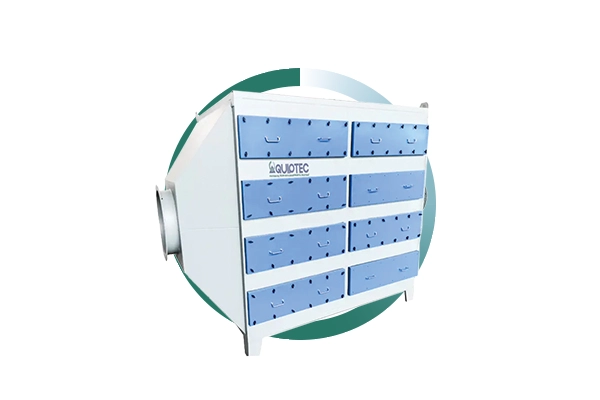
Drawer-Type Activated Carbon Filter





| Model | Air volume range | Device size
(mm) |
Wind area
(m²) |
Wind speed range
(m/S) |
Equipment material |
| AQT-2000 | 2000 | 1800×800×1000 | 1.2 | 0.5 | PP/201/304/Q235 |
| AQT-5000 | 5000 | 2200×1200×1200 | 2.78 | 0.5 | PP/201/304/Q235 |
| AQT-8000 | 8000 | 2200×1000×2000 | 4.45 | 0.5 | PP/201/304/Q235 |
| AQT-10000 | 10000 | 2400×1200×2000 | 5.56 | 0.5 | PP/201/304/Q235 |
| AQT-12000 | 12000 | 2600×1200×2000 | 6.67 | 0.5 | PP/201/304/Q235 |
| AQT-15000 | 15000 | 3000×1200×2000 | 8.34 | 0.5 | PP/201/304/Q235 |
| AQT-18000 | 18000 | 3000×1500×2000 | 10 | 0.5 | PP/201/304/Q235 |
| AQT-20000 | 20000 | 3200×1500×2000 | 11.2 | 0.5 | PP/201/304/Q235 |
| AQT-25000 | 25000 | 3600×1500×2000 | 13.9 | 0.5 | PP/201/304/Q235 |
| AQT-30000 | 30000 | 3500×2000×2000 | 16.67 | 0.5 | PP/201/304/Q235 |

Features
Standard Features
- Activated carbon media with high adsorption capacity
- Drawer-type structure for easy carbon replacement
- Carbon steel construction for durability
- Uniform airflow distribution for effective adsorption
- Multi-layer filtration design for improved efficiency
- Compact modular structure for easy installation
Options & Accessories
- Stainless steel construction for corrosive environments
- Different carbon types (granular, pellet, powder)
- Pre-filtration system for dust removal
- PLC control system and monitoring devices
- Customised dimensions and capacity

Working Principle
The Drawer Type Activated Carbon Filter operates based on the adsorption principle using porous activated carbon media. Organic exhaust gases are drawn into the system under negative pressure generated by a blower and directed through the activated carbon filter bed. Due to the highly porous structure of the activated carbon, its surface contains unbalanced molecular forces that attract gas molecules.
When the contaminated air encounters the carbon surface, pollutants are captured and concentrated within the pores through physical and chemical adsorption. As the gas flows through the carbon layer, organic compounds, odours, and harmful gases are retained on the surface of the activated carbon, effectively separating them from the air stream.
The purified air is then discharged from the system, while the contaminants remain adsorbed within the carbon media. Over time, the adsorption capacity decreases, and the carbon is replaced or regenerated through the drawer-type system to maintain performance.

Key Benefits
- High-Efficiency Gas and Odour Removal
Effectively removes organic pollutants, odours, and harmful gases through adsorption, ensuring cleaner exhaust air and improved environmental compliance. - Advanced Adsorption Performance
Activated carbon media provides a highly porous structure with a large surface area, enabling efficient capture of volatile organic compounds and chemical contaminants. - Modular Drawer-Type Design
Drawer configuration allows easy removal and replacement of carbon media, simplifying maintenance and reducing downtime. - Stable and Reliable Operation
Operates without complex moving parts, ensuring consistent performance and long service life in industrial environments. - Flexible Application Range
Suitable for a wide range of air purification applications, including industrial exhaust treatment and odour control systems. - Low Operating Cost
An energy-efficient adsorption process requires minimal power consumption, reducing overall operating expenses.


