
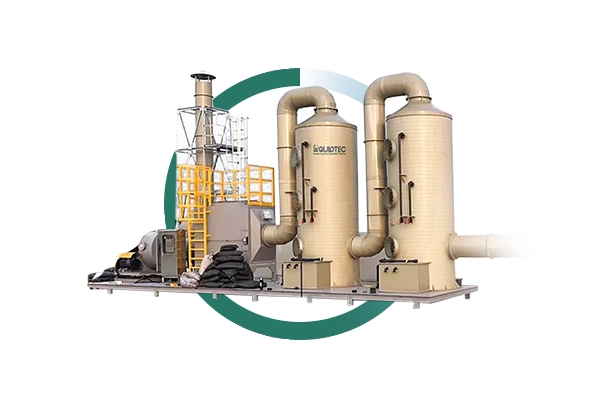
Wet Scrubber System





| Model | Airflow Capacity (m³/h) | Equipment Dimensions | Pump Power (kw) | Packing thickness | Wind speed
(m/s) |
Equipment Material |
| AQT-600 | 0-1500 | Φ600×3000 | 0.75 | 500*2 | 1.48 | PP/304/Q235/FRP |
| AQT-800 | 1501-2500 | Φ800×3000 | 0.75 | 500*2 | 1.39 | PP/304/Q235/FRP |
| AQT-1000 | 2501-4000 | Φ1000×5000 | 1.5 | 500*2 | 1.42 | PP/304/Q235/FRP |
| AQT-1200 | 4001-6000 | Φ1200×5000 | 2.2 | 500*2 | 1.48 | PP/304/Q235/FRP |
| AQT-1500 | 6001-9500 | Φ1500×5000 | 3.75 | 500*2 | 1.5 | PP/304/Q235/FRP |
| AQT-1800 | 9501-14000 | Φ1800×5000 | 5.5 | 500*2 | 1.53 | PP/304/Q235/FRP |
| AQT-2000 | 14001-17000 | Φ2000×6000 | 5.5 | 500*2 | 1.5 | PP/304/Q235/FRP |
| AQT-2200 | 17001-20000 | Φ2200×6000 | 7.5 | 500*2 | 1.46 | PP/304/Q235/FRP |
| AQT-2500 | 20001-27000 | Φ2500×6000 | 7.5 | 500*2 | 1.53 | PP/304/Q235/FRP |
| AQT-2800 | 27001-33000 | Φ2800×6000 | 15 | 500*2 | 1.49 | PP/304/Q235/FRP |
| AQT-3000 | 33001-38000 | Φ3000×6800 | 15 | 500*2 | 1.49 | PP/304/Q235/FRP |
| AQT-3200 | 38001-44000 | Φ3200×6800 | 15 | 500*2 | 1.52 | PP/304/Q235/FRP |
| AQT-3500 | 44001-55000 | Φ3500×6800 | 15 | 500*2 | 1.5 | PP/304/Q235/FRP |

Features
Standard Features
- Gas–liquid contact system selected to suit the application
- Spray nozzles, packed media, venturi throat, or hybrid contact arrangement
- Recirculation tank or integrated sump for liquid collection
- Recirculation pump and distribution pipework
- Mist eliminator/demister at treated gas outlet
- Inspection ports and maintenance access
- Corrosion-resistant construction materials
- Simple, reliable operation for continuous gas treatment
- Customised inlet/outlet orientation to suit site layout
- Suitable for water, alkaline, acidic, or chemically dosed scrubbing liquids
Options & Accessories
Scrubber Configuration Options:
- Spray tower scrubber
- Packed-bed scrubber
- Venturi scrubber
- Tray or impingement scrubber
- Multi-stage or hybrid wet scrubber system
Material Options:
- Polypropylene
- PVC/UPVC
- FRP
- SS304 / SS316 stainless steel
- Carbon steel with internal lining or coating, where suitable

Working Principle
A wet scrubber system operates by bringing a contaminated gas stream into controlled contact with a scrubbing liquid. The scrubbing liquid may be water, an alkaline solution, an acidic solution, an oxidising reagent, or another selected chemical, depending on the pollutant to be removed. The gas stream enters the scrubber and passes through one or more gas–liquid contact zones.
In a spray tower, atomising nozzles distribute liquid droplets across the gas path. In a packed-bed scrubber, the gas passes through random or structured packing, where a wetted surface provides a high contact area for absorption and chemical reaction. In a venturi scrubber, the gas is accelerated through a narrow throat where intense turbulence improves fine particulate and mist capture.
Hybrid scrubbers may combine these mechanisms to improve performance for complex exhaust streams. During contact, soluble gases dissolve into scrubbing liquid, acidic or alkaline contaminants are neutralised by chemical reaction, and entrained particles or droplets are captured by impaction, interception, or condensation. The treated gas then passes through a demister or mist eliminator to remove entrained liquid droplets before discharge to the atmosphere or downstream treatment. The spent scrubbing liquid is collected in the sump or recirculation tank.
Depending on the process design, the liquid may be recirculated, dosed with chemicals, filtered, partially discharged, or replaced. Instrumentation such as pH, ORP, conductivity, level, flow, and pressure monitoring can be included for stable and automated operation.

Key Benefits
- Efficient Gas Absorption and Pollutant Removal
Wet scrubber removes harmful gases, acid mist, alkaline fumes, soluble contaminants, odours, and selected particulate matter through controlled gas–liquid contact. Depending on the application, removal occurs by absorption, chemical neutralisation, condensation, impaction, and droplet capture.
- Multiple Wet Scrubber Configurations
Available in spray tower, packed-bed, venturi, tray/impingement, and hybrid configurations. The final arrangement is selected based on gas flow rate, pollutant type, removal efficiency, pressure drop, fouling risk, and chemical compatibility.
- Flexible Material Options for Corrosive Environments
Available in stainless steel, FRP, polypropylene, PVC/UPVC, and other corrosion-resistant materials. Materials are selected according to gas composition, temperature, pH, chemical dosing requirements, and long-term operating conditions.
- Low to Moderate Energy Consumption
Designed for efficient operation with optimised pressure drop, recirculation flow, spray distribution, and gas–liquid contact efficiency. Venturi systems may require a higher pressure drop where fine particulate or mist removal is required.
- Wide Industrial Applicability
Suitable for treating acid gases, acid mist, alkaline fumes, odours, VOC-associated soluble gases, chemical vapours, dust-laden exhaust, and process ventilation streams across water, wastewater, chemical, fertiliser, metal finishing, food processing, and environmental applications.
- Stable and Continuous Operation
Engineered for reliable gas–liquid interaction using spray nozzles, packing media, demisters, recirculation tanks, chemical dosing systems, and optional pH/ORP control to maintain consistent treatment performance.
- Extended Service Life and Operational Reliability
Designed for long-term industrial use with corrosion-resistant construction, accessible maintenance points, replaceable mist eliminators, packing support systems, and robust recirculation pumps.
- Cost-Effective Pollution Control Solution
Provides a practical and economical solution for primary and secondary gas treatment, emission reduction, odour control, and compliance support.


